J&R Product · 001
KAIROS
True Profit
Intelligence
for Shopify.
Kairos brings the information behind a Shopify store together so merchants can understand more than what they sold. The goal is to make profitability, inventory and other important signals easier to see and easier to act on.
The problem
Revenue is easy to see.
Profit is not.
A Shopify store can show exactly how much it sold, while the answer to a much more important question — how much did the business actually keep? — can still be surprisingly difficult to find.
Product costs, inventory, operating expenses and customer information often live in different places. Looking at any one of them alone only gives part of the picture.
Kairos brings those signals together so a merchant can better understand where profit is being made, where margin may be disappearing and what deserves attention.
- Orders
- Product costs
- Inventory
- Operating costs
- Customer signals
Kairos
- Profitability
- Inventory
- Store insights
Why it needs to be a product
The store keeps changing.
The numbers have to keep up.
Today, that includes work around:
- Product profitability
- Margin risk
- Missing or incomplete cost information
- Inventory signals
- Customer and commerce data
Orders come in. Inventory moves. Costs change. Customers behave differently over time.
That means profitability cannot be treated as a spreadsheet someone updates once or a report that is already outdated by the time it is opened.
Kairos is designed as an ongoing system. As the store changes, the product can refresh its data, recalculate the numbers and keep the information useful without asking the merchant to rebuild the analysis every time.
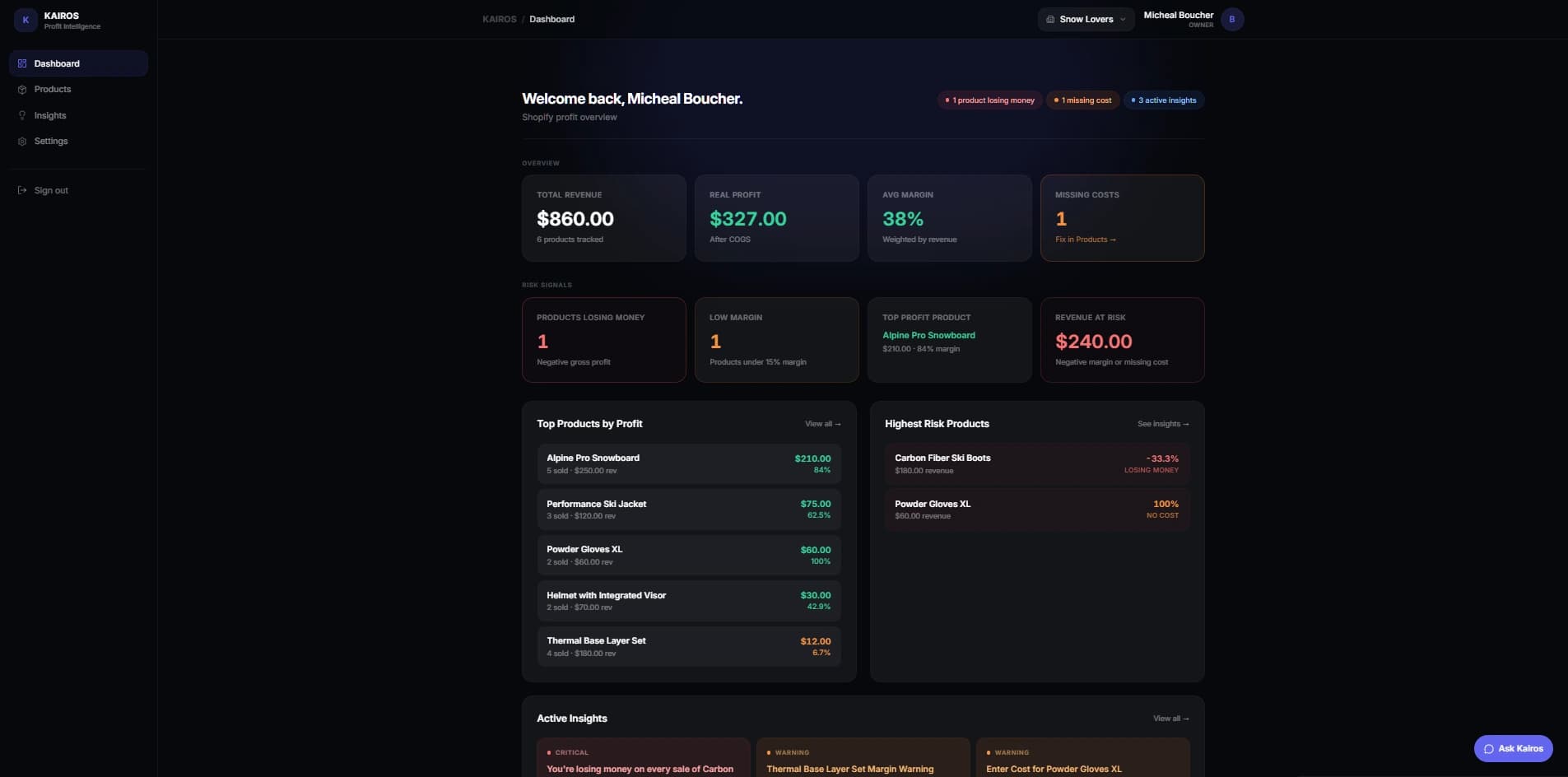
System architecture
Built as a
connected system.
Shopify remains the source of the store’s commerce data. Kairos brings that information into a structure it can work with, performs the calculations in a dedicated service, stores the results and presents them through the product.
The important part is not that several technologies are involved. It is that each part has a clear responsibility and the boundaries between them are deliberate.
Automatic refresh
Important store information can update in the background instead of depending entirely on someone opening a page and pressing a button.
Current stack
TypeScript · React · Express · Python · FastAPI · PostgreSQL · Prisma · Shopify GraphQL
Shopify
Products, orders and other store information enter Kairos through Shopify’s APIs.
Application backend
The backend handles access to the product, coordinates data between the different parts of the system and keeps each store’s information separated.
Data
Commerce data is organized into a consistent structure so the product can work with it reliably instead of repeatedly interpreting raw Shopify responses.
Calculation service
A dedicated service handles profitability and other calculations that need to produce consistent results from the same data.
Product interface
The interface turns those results into something a merchant can actually use: numbers, findings and questions about the store.
Engineering
The engineering work is
mostly about trust.
For a product like Kairos, getting a calculation to work once is only the beginning. The harder part is making sure the system continues to behave sensibly when data is incomplete, another service is unavailable or something changes unexpectedly.
- 01Problem
One service should not take down the whole product.
Approach
Kairos relies on several services working together. They are designed so that if one becomes unavailable, the failure can be contained instead of spreading through the rest of the product. The system avoids repeatedly sending requests to a service that is already having trouble, and users receive a clear response instead of an unexplained technical error.
Why it matters
A temporary problem in one part of Kairos should remain a problem in that part of Kairos.
- 02Problem
The period has to match the question.
Approach
Profitability only means something when the dates behind it are correct. If a merchant asks for one period and the result is not ready, Kairos does not quietly substitute data from another period or turn missing information into a convincing-looking zero.
Why it matters
A number can look completely reasonable and still be wrong for the decision someone is trying to make.
- 03Problem
Freshness has to match how the data actually updates.
Approach
Kairos keeps track of whether important information is still current based on how that information is expected to refresh. That lets the product distinguish between data that is genuinely out of date and data that simply has not reached its next scheduled update yet.
Why it matters
A warning is only useful when it reflects what is actually happening in the system.
- 04Problem
Store access is treated as sensitive.
Approach
Connecting Kairos to Shopify means handling credentials that can access a merchant’s store. Those credentials are protected when stored, kept away from the browser and logs, and only made available where the system actually needs them. Kairos also checks critical security configuration before running instead of waiting for a real request to discover that something important is missing.
Why it matters
The product cannot ask merchants to trust its numbers without taking the protection of their store seriously.
Where AI sits
AI explains the numbers.
It doesn’t create them.
Profitability and other core metrics in Kairos are calculated from the store’s data. The same information should produce the same result regardless of how many times the calculation runs.
AI comes afterward. It can help explain what the product has found and let a merchant ask questions about their own store in plain language. It does not decide what the profit number should be, and the core calculations do not depend on the assistant being available.
That separation is intentional: AI is useful for helping someone understand information, but the numbers themselves need a more predictable foundation.
Current state
Kairos is still
in development.
The current work is focused on the parts that make the product dependable: data correctness, reliability, security, integrations and making the information easier to understand.
There is no launch date or business-performance claim attached to this case study. Kairos is an active product being developed, tested and improved as the system encounters more realistic conditions.
What building Kairos requires
Building the product means
working across the whole system.
Kairos touches several different areas of software at once.
Product thinking
Deciding what information is useful to a merchant and how it should be presented.
Shopify integration
Bringing changing commerce data into the product reliably.
Backend & data
Organizing that information and keeping different stores properly separated.
Calculation systems
Producing financial and operational metrics consistently.
Frontend
Turning those results into something understandable and useful.
Reliability & security
Making sure failures are controlled and sensitive store access is protected.
The difficult part is not using each of those technologies independently. It is getting them to work together as one product.
Kairos is still evolving.
The current version is live as a product preview while development continues.